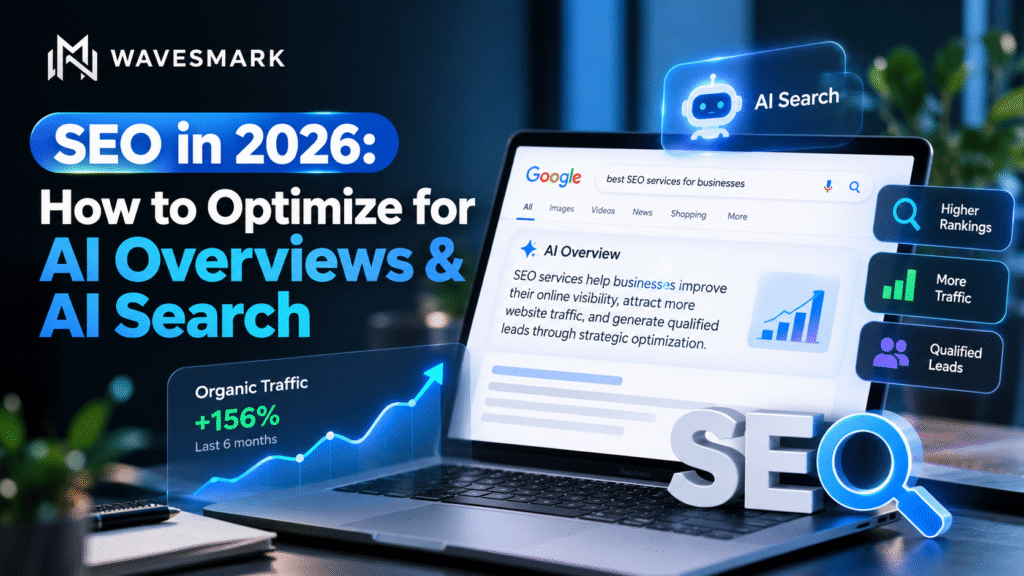
Search engine optimization is changing rapidly in 2026. For years, businesses focused primarily on ranking their websites among Google’s traditional organic results. Today, search is becoming more conversational and increasingly influenced by artificial intelligence.
Google AI Overviews and AI Mode are changing how people discover information, compare businesses, research products, and make purchasing decisions. At the same time, users are increasingly using AI platforms to find answers and recommendations.
This doesn’t mean traditional SEO is dead. Instead, businesses need to expand their SEO strategy to make their websites useful and visible across both traditional search and AI-powered discovery.
What Is Changing in SEO in 2026?
Traditional SEO has largely focused on keywords, rankings, backlinks, technical optimization, and organic traffic.
Those elements still matter, but search behavior is evolving.
Google’s search experience now includes AI-powered features that can summarize information and provide users with answers directly in the search results. Google also continues to emphasize helpful, reliable, people-first content rather than content created primarily to manipulate rankings. Google for Developers
As a result, businesses need to think beyond:
“How do I rank #1?”
The better question is:
“How can my brand become a trusted source that search engines and AI systems can understand, recommend, and reference?”
1. Optimize for AI Overviews and AI Search
One of the biggest SEO trends in 2026 is the growth of AI-powered search experiences.
Recent industry data shows that Google AI Overviews appeared in 39.4% of U.S. desktop searches in June 2026, up significantly from the previous year. Search Engine Land
This creates a new opportunity for businesses.
Instead of optimizing content only for traditional rankings, businesses should create content that clearly answers the questions their customers are asking.
For example, instead of creating a generic page targeting “SEO services,” an agency could create useful resources such as:
- What does SEO cost for a small business?
- How long does SEO take to work?
- Is SEO better than Google Ads?
- How can local businesses improve Google rankings?
- What are the most important SEO strategies in 2026?
Answer-focused content gives search engines more context about your expertise and the topics your business covers.
2. Focus on Helpful, Original Content
AI can generate content quickly, but publishing large amounts of generic AI-generated content is not an effective SEO strategy.
Google’s current guidance emphasizes content that is helpful, reliable, original, and created primarily for people. Google specifically recommends evaluating whether content provides original information, substantial value, useful analysis, and a satisfying experience for readers. Google for Developers
Businesses should therefore focus on:
- Original insights.
- Real examples.
- Expert opinions.
- Case studies.
- First-hand experience.
- Data and research.
- Detailed answers to customer questions.
The goal should be to create content that provides something more useful than what is already available online.
3. Build Topic Authority Instead of Targeting Individual Keywords
Modern SEO is moving beyond simply creating one page for one keyword.
Search engines increasingly need to understand the broader context of a website.
For example, an SEO agency targeting “SEO services” could create a group of interconnected resources covering:
- Technical SEO.
- Local SEO.
- On-page SEO.
- Keyword research.
- Link building.
- SEO audits.
- Ecommerce SEO.
- Enterprise SEO.
- AI search optimization.
- SEO reporting.
This creates a stronger topical structure and helps demonstrate expertise around the broader subject.
4. Make Your Content Easy for AI Systems to Understand
AI-powered search systems need to interpret information from websites.
Clear website structure can make this easier.
Businesses should use:
- Descriptive headings.
- Clear page titles.
- Short and informative paragraphs.
- Relevant internal links.
- Structured content.
- Descriptive URLs.
- Appropriate structured data.
- Clear business information.
Google explains that structured data can help it understand page content and potentially support richer search appearances. Google for Developers
However, structured data should support genuinely useful content rather than being treated as a shortcut to rankings.
5. Strengthen Your Brand’s Online Presence
AI search is not only about individual web pages.
Brand recognition and the information available about your business across the web can also become increasingly important as users search for recommendations and comparisons.
Businesses should maintain consistent information across:
- Website.
- Google Business Profile.
- Social media profiles.
- Business directories.
- Industry websites.
- Review platforms.
- Relevant publications.
The stronger and more consistent your online presence, the easier it can be for users and search systems to understand your business.
6. Don’t Ignore Local SEO
For businesses serving specific cities or regions, local SEO remains extremely important.
A local customer might search:
“best plumber near me”
or:
“SEO agency in Toronto”
or:
“roofing company in Sarasota.”
Businesses should optimize their local presence with accurate business information, location-specific pages, customer reviews, useful local content, and a well-maintained Google Business Profile.
Local SEO and AI search should not be treated as separate strategies. They can work together to improve visibility when customers search for local businesses.
7. Think About GEO Alongside SEO
Generative Engine Optimization, commonly called GEO, focuses on improving the likelihood that a brand or its content is mentioned, cited, or recommended within AI-generated answers.
Industry discussions around 2026 SEO increasingly include GEO alongside traditional search optimization. Ahrefs
For businesses, this means creating content that is:
- Accurate.
- Well-structured.
- Authoritative.
- Relevant.
- Easy to understand.
- Supported by credible information.
- Focused on real customer questions.
However, GEO should not replace SEO.
A stronger strategy is to build a foundation of traditional SEO while also making content useful for AI-powered discovery.
8. Improve Technical SEO
Even with the growth of AI search, technical SEO remains an important part of website optimization.
Businesses should regularly review:
- Website speed.
- Mobile usability.
- Indexability.
- Crawlability.
- Broken links.
- Canonical URLs.
- XML sitemaps.
- HTTPS.
- Internal linking.
- Page structure.
- Core Web Vitals.
A technically strong website provides a better foundation for both search engines and users.
9. Measure Business Results, Not Just Rankings
SEO reporting is also changing.
A business may rank for hundreds of keywords but still generate very few customers.
Instead of focusing only on rankings, businesses should track metrics such as:
- Organic traffic.
- Qualified leads.
- Form submissions.
- Phone calls.
- Sales.
- Conversion rates.
- Revenue from organic search.
- Branded search growth.
The real purpose of SEO is not simply to achieve higher rankings. It is to help a business attract the right audience and generate measurable business results.
10. Combine SEO With Other Digital Marketing Channels
SEO becomes even more powerful when combined with other marketing channels.
For example:
SEO + Content Marketing can build long-term organic visibility.
SEO + Google Ads can help businesses capture both paid and organic search demand.
SEO + Social Media Marketing can increase content distribution and brand awareness.
SEO + Website Optimization can turn more visitors into enquiries and customers.
A connected digital marketing strategy can create better results than relying on one channel alone.
The Future of SEO Is Search Visibility
SEO in 2026 is no longer simply about getting a webpage to rank among ten blue links.
Search is becoming more conversational, visual, and AI-driven. Google AI Overviews and AI Mode are changing how users interact with search, while AI platforms are creating additional ways for people to discover businesses and information. Search Engine Land
Businesses that continue creating useful content, building authority, improving technical SEO, strengthening their brands, and adapting to AI-powered search can be better positioned for the changing search landscape.
The goal is simple:
Be visible where your customers are searching.
How Wavesmark Can Help With SEO
At Wavesmark, we help businesses improve their online visibility through strategic search engine optimization.
Our SEO approach can include:
- Keyword research.
- On-page SEO.
- Technical SEO.
- Local SEO.
- Content optimization.
- Competitor research.
- Link building.
- SEO audits.
- Performance tracking.
- Search visibility strategies.
Whether your goal is to increase organic traffic, generate more qualified leads, improve local visibility, or strengthen your online presence, a strategic SEO campaign can help build sustainable long-term growth.
Want to improve your website’s search visibility in 2026?
Explore Wavesmark’s Search Engine Optimization Services and discover how a strategic SEO approach can help your business attract more relevant traffic and generate more opportunities.